

This website uses cookies to improve your experience. We'll assume you're ok with this, but you can opt-out if you wish. Read More
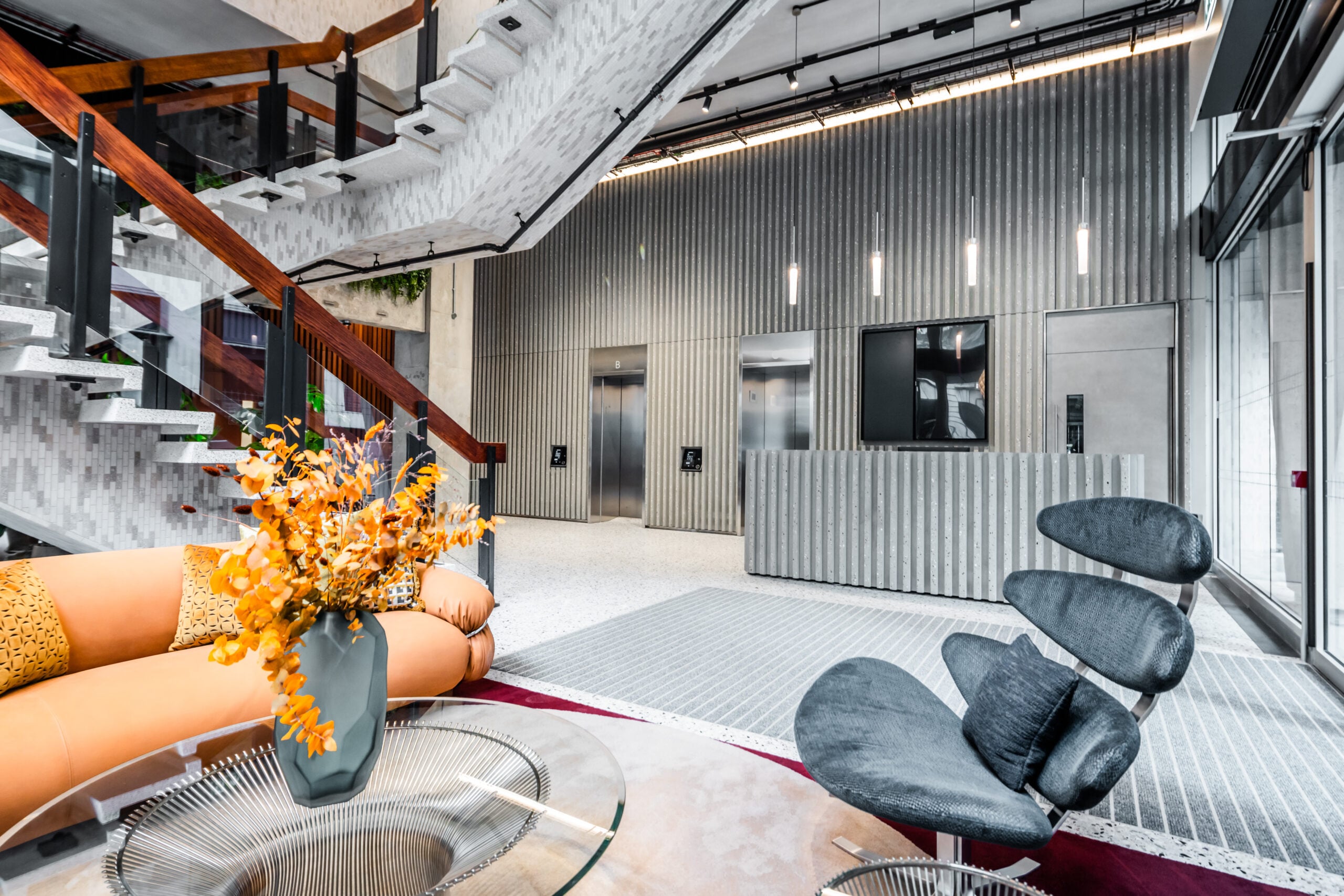
A concrete reception desk is a bespoke, hand-cast feature counter for commercial lobbies, made from glass fibre-reinforced concrete (GFRC) or surface-grade concrete. It delivers premium aesthetics with high durability, supports custom edge profiles, colours and finishes, and resists stains once sealed. Successful specification depends on early design input, sample approval, and careful planning for weight, access and installation.
Table of Contents
The reception desk is the first thing a visitor sees when they walk into your building. It sets the tone for the entire space — the moment a brand makes its first physical impression. A concrete reception desk meets that brief with a material that is at once architectural, tactile and enduring, giving specifiers a feature piece that reads as sculpture as much as furniture.
This guide is written for the interior designers, architects and developers who specify these pieces. It walks through where concrete reception desks work, the design and finish options available, how sealing protects the surface, the practical realities of weight and access, and how concrete compares to other commercial surface materials. The aim is simple: to help you map a concrete reception desk onto your exact project scenario, from concept to specification.
At MASS Concrete, bespoke reception desks sit within a broader range of crafted concrete surfaces — from servery counters and boardroom tables to feature wall panels and bar tops. Every piece is hand-cast to a client’s exact aesthetic and practical brief.
Where do concrete reception desks work in commercial spaces?
Concrete reception desks earn their place wherever a space needs a confident, hard-wearing focal point. Commercial lobbies are the obvious home — a double-height office reception, a hotel check-in counter, a gallery foyer — but the material is equally at home across retail, hospitality and public-sector environments.
Typical settings include:
- Corporate office receptions and building entrance lobbies
- Hotel check-in and concierge counters
- Retail store service points and till counters
- Gallery, museum and cultural venue welcome desks
- University and campus reception areas
- Healthcare and clinic front-of-house desks
The reasoning is partly aesthetic and partly practical. Reception counters take constant contact, the occasional knock from luggage and trolleys, and years of daily traffic. Concrete absorbs that punishment without losing its character. Guidance on lobby planning from the Whole Building Design Guide notes that a reception desk should sit as a clutter-free element with direct visual access to the entry, supported by ample, elegant lighting — a brief a sculptural concrete counter answers naturally.
What edge profiles and design options are available?
This is where a concrete reception desk stops being a counter and becomes a piece of the building’s design language. Because each desk is hand-cast to order, almost every dimension can be tailored to your drawings.
Customisation options include:
- Edge profiles — square and true, softened arrises, chamfered or shaped returns, with profiles kept consistent along the full run
- Colour — plain or speckled mixes, colour-matched to brand palettes or surrounding finishes
- Embedded materials — quartz, granite, recycled glass, mother of pearl, shells or metal shavings worked into the mix
- Texture — polished, honed, board-marked or bespoke surface detail
- Form — curved, faceted, cantilevered or large-format casts, with shadow gaps and jointed panels used as deliberate features
- Branding — etched logos, debossed lettering and integrated signage
Consistency matters as much as choice. The Concrete Countertop Institute’s quality standards set out useful benchmarks for bespoke surfaces: edge profiles should stay consistent along the length and match closely across seams, vertical edges should be square and true to the top surface, and corners and arrises should be clean and uniform. For a desk visible to every visitor, these tolerances protect the design intent.
A sample-led approval process underpins all of this. Concrete is a natural material, and tonal variation is part of its character — agreeing a benchmark sample early ensures the finished desk matches the look you and your client signed off.
How do sealing and stain resistance protect the surface?
A reception desk lives with coffee cups, pens, hand sanitiser and visitor logbooks. Stain resistance is therefore a core specification concern, not an afterthought.
The protection comes from sealing. A durable sealant system shields the surface against virtually all common staining agents. The Concrete Countertop Institute grades stain resistance by how long a sealed surface resists 12 everyday agents — including coffee, red wine, vinegar and bleach — with Grade 1 sealers holding out for a full 24 hours of continuous exposure. For a busy commercial counter, a high-performing sealer keeps the surface looking as it did on day one.
MASS Concrete surfaces are finished with a durable sealant system that protects against virtually all types of stains, and are backed with a high-density foam product that makes them lighter than standard concrete — an advantage worth knowing when you reach the installation stage.
What are the access and lifting considerations?
Here is the honest, practical part of the conversation — the one that protects both your programme and the people on site. Concrete is heavy, and a reception desk is large. Planning for weight and access early prevents expensive surprises during installation.
Two factors ease the load. First, material choice: glass fibre-reinforced concrete is cast in thin sections, typically 13 to 25mm, making it far lighter than solid concrete while keeping its strength. Second, casting strategy: large desks are often cast in several pieces — as at Hammersmith, where the eight-metre front face was split into four panels with a maximum panel size of two metres by one metre, removing the need for steel reinforcement and keeping each section manageable.
Handling still demands care. OSHA guidance on heavy lifting notes that loads over 50 pounds (around 23kg) increase the risk of injury, and recommends mechanical aids, two-person lifts and proper power-zone technique. Mobile vacuum lifting equipment was used at Hammersmith to manoeuvre the large sections safely into place.
A few planning points to raise early with your contractor:
- Access routes — door widths, corridors, lift dimensions and floor protection for the delivery path
- Lifting method — vacuum lifters, two-person handling or mechanical aids for larger panels
- Substructure — a purpose-built frame to receive and support the cast sections
- Sequencing — when in the programme the desk arrives relative to surrounding finishes
At MASS Concrete, installation considerations are discussed throughout the design process, because panel size, handling and site access shape the design itself.
How do you integrate a concrete desk with joinery and lighting?
A reception desk rarely stands alone. It works hardest when it integrates cleanly with surrounding joinery, services and lighting — and concrete gives you the design latitude to do that elegantly.
Cast knockouts and cutouts can be designed in from the start for cable management, monitors, lighting and lift-call panels. The desk can be fixed to a purpose-designed wooden frame, allowing joinery and concrete to meet with crisp shadow gaps rather than awkward junctions. Hammersmith’s reception desk used an elegant 3mm shadow gap fixed to a purpose-built frame — a detail that reads as deliberate craft.
Lighting deserves particular thought. Lobby planning guidance recommends a combination of ceiling-mounted, indirect and task lighting at the desk, and concrete responds beautifully to grazing light that picks out texture and tone. Integrated LED detailing, under-counter washes and recessed feature lighting can all be planned into the cast.
The practical takeaway: bring these requirements to the design table early. When cutouts, fixings and lighting are designed into the cast rather than retrofitted, the result is seamless — and the contractor’s job is far simpler.
What maintenance does a concrete reception desk need?
Concrete reception desks are low maintenance, but not no maintenance. A short, sensible routine keeps a desk looking its best for decades.
- Daily — wipe with a soft cloth and pH-neutral cleaner; avoid harsh acidic or abrasive products
- Regular — inspect for any surface marks and address spills promptly, even on a sealed surface
- Periodic — reseal in line with the supplier’s recommendation to maintain stain resistance over years of use
Because the surface derives much of its protection from the sealant, sealing is the single most important maintenance task. Kept sealed, a concrete desk resists staining, shrugs off daily wear and ages gracefully — hairline surface marks, where they appear, are a natural characteristic of the material rather than a defect.
What is the best concrete for furniture: GFRC or traditional concrete?
For most reception desks, glass fibre-reinforced concrete (GFRC) is the stronger specification — and understanding why helps you brief it correctly.
GFRC is a composite of alkali-resistant glass fibres in a cementitious mix. According to the American Concrete Institute’s report on GFRC, it offers desirable aesthetics alongside durability, strength, toughness, moisture resistance, dimensional stability and fire resistance. Because it contains no steel reinforcement, GFRC needs no extra cover to protect against corrosion, so it can be cast in thin sections of roughly 13 to 25mm — far thinner than the 50mm-plus typical of conventional concrete, and considerably lighter.
Choose GFRC when:
- The desk is large or spans several metres and weight is a concern
- Access is tight and panels must stay manageable
- You want thin, refined edges and crisp detailing
Choose a solid surface-grade concrete when:
- The piece is smaller and a heavier, monolithic feel is wanted
- The design calls for deep aggregate exposure or a substantial cast section
In practice, a specialist will recommend the right mix for your design, balancing span, weight, finish and access. The point is that “”concrete”” is not a single material but a family of mixes — each tuned to a different brief.
How does concrete compare to other commercial surface materials?
Concrete sits comfortably alongside solid surfaces, porcelain and natural stone, and outperforms several of them on the qualities that matter for a reception desk.
Against solid surfaces (such as acrylic composites), concrete offers a more authentic, tactile depth and far greater design freedom in colour, aggregate and form. Against natural stone, concrete can be cast to any shape and colour-matched to a brand, where stone is constrained by what the quarry yields. Against porcelain, concrete delivers a seamless, monolithic surface with bespoke edge profiles rather than tiled junctions.
Its core credentials are well established. The Concrete Centre describes exposed concrete as durable and hard-wearing, suited to everything from warehouses to art galleries, and capable of reading as utilitarian or luxurious depending entirely on the chosen materials and finish. That range — industrial honesty at one end, refined luxury at the other — is precisely what makes it such a versatile choice for commercial interiors.
Choose concrete when durability, bespoke design and a premium tactile finish all matter at once. For a reception desk that must look exceptional and survive years of public use, few materials make a stronger case.
Frequently asked questions
How much does a concrete reception desk cost?\
Cost depends on size, complexity, finish and the number of cast sections. A large, multi-panel desk with bespoke colour-matching and integrated lighting sits at the higher end, while a simpler counter is more economical. The most accurate route is to share your drawings for a tailored quote.
How heavy is a concrete reception desk?\
Weight varies with material and dimensions. GFRC is cast in thin sections of roughly 13 to 25mm, making it considerably lighter than solid concrete. Large desks are usually cast in several panels to keep each section manageable and to ease access and handling on site.
How long does a concrete reception desk take to make and install?\
Production timelines depend on the design and finish, so it is best to agree a realistic programme early. As a guide on installation pace, the Hammersmith project’s pre-cast concrete elements took around one week to install on site once delivered.
Will the finished desk match the approved sample?\
A sample-led approval process is used to agree a benchmark before manufacture. Concrete is a natural material with subtle tonal variation, which is part of its character — agreeing a sample early ensures the finished desk meets you and your client’s expectations.
Is a concrete reception desk suitable for high-traffic commercial environments?\
Yes. Concrete is durable, fire-resistant and hard-wearing, and once sealed it resists staining from common agents. These qualities make it well suited to busy public, retail and hospitality settings.
Can we incorporate our brand colours and logo?\
Yes. Mixes can be colour-matched to brand palettes, and logos or lettering can be etched, debossed or embossed into the surface. Embedded materials such as recycled glass or metal can also reinforce a brand’s identity.
Send us your desk drawings
The best way to understand how a concrete reception desk fits your project is to put it in front of people who cast them every day. Share your desk drawings with the MASS Concrete team and we will review the design, advise on the right mix, finish, edge profiles and fixings, and flag any access or weight considerations before they reach the site.
From the early design stage through to a finished, installed piece, MASS Concrete works closely with your design team to deliver a reception desk that sets your project apart. Speak to our team on 01202 628 140 to start the conversation.