

This website uses cookies to improve your experience. We'll assume you're ok with this, but you can opt-out if you wish. Read More
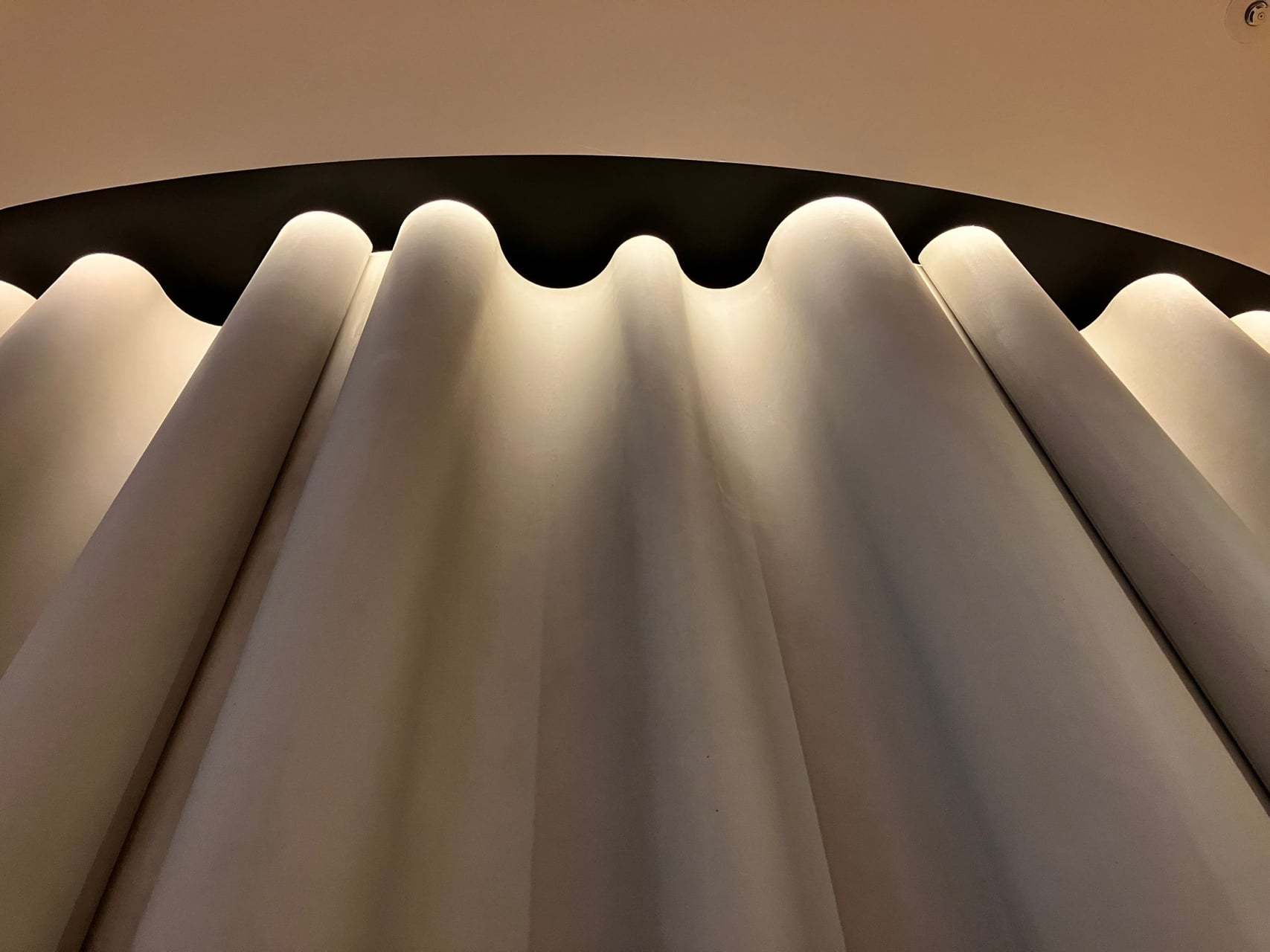
Bespoke Concrete vs Porcelain Slabs for Feature Walls
Quick answer: Porcelain slabs deliver a clean, low-maintenance, near-seamless surface, ideal when a flawless flat finish and minimal upkeep are the priority. Bespoke concrete offers tactile depth, three-dimensional form, and finishes matched to your brand, ideal when the feature wall must carry the design narrative. The right choice depends on whether you want surface or substance.
A commercial feature wall does more than fill a vertical plane. It sets the tone of a reception, anchors a retail interior, and signals the calibre of the brand behind it. When the specification lands on your desk, two materials dominate the shortlist: porcelain slabs and bespoke concrete. Both can look extraordinary. Neither is the obvious default.
This decision brief gives you the criteria to defend your choice at tender, in front of a client, or against a value-engineering challenge. We compare texture, panel sizes and fixing, durability, maintenance, cost, and design intent, drawing on technical standards and authoritative guidance throughout. By the end, you will know exactly when porcelain wins, when bespoke concrete wins, and how to articulate why.
Bespoke concrete vs porcelain slabs: a side-by-side comparison
Here is the short version before we go deeper.
| Criterion | Bespoke Concrete | Porcelain Slabs |
|---|---|---|
| Surface character | Tactile, dimensional, can be sculpted, textured, and shaped | Flat, smooth, near-seamless with minimal grout lines |
| Customisation | Bespoke colour, texture, shape, cutouts, embossing, inlays | Wide range of printed effects mimicking stone, wood, and concrete |
| Typical panel size | Made to order, including 1m² and 1500mm × 1000mm | From 1m × 3m up to 1.60m × 3.20m for gauged panels/slabs |
| Fixing | Mechanical hanging systems, face-fixing, or adhesive bonding | Bonded to a flat substrate with deformable adhesive |
| Substrate demand | Defined by panel weight and fixing method | Very flat substrate required; tighter than SR1 for panels |
| Durability | Fire, weather, and impact resistant; long lifespan | Impervious, non-combustible, hardwearing |
| Maintenance | Periodic sealing to maintain stain and UV resistance | Wipe-clean, non-porous, minimal upkeep |
| Best for | Walls that must carry the design story | Walls that demand a flawless, low-maintenance plane |
The headline distinction is simple. Porcelain slabs create a clean surface. Bespoke concrete offers a tactile, dimensional expression. Everything that follows builds on that contrast.
Texture and aesthetic appeal: surface versus substance
This is where the two materials part company most decisively.
Porcelain slabs are prized for a flat, refined, almost uninterrupted plane. Large format porcelain reduces grout lines to create seamless finishes that feel modern and spacious, and the technology has advanced to deliver hyper-realistic wood, concrete, and stone effects, as The Tile Association notes. For a design brief that calls for a continuous, calm, gallery-clean backdrop, porcelain answers convincingly. The trade-off is that the depth lives in the print, not the material. What you see is a printed surface, however convincing.
Bespoke concrete works the other way. The texture is the material. Through form liners, the casting process can impart almost any surface — board-mark textures, flutes, geometric patterns, rock-face, or a tooled profile. The Architectural Precast Association’s finishes guide puts it plainly: with form liners, the detail is “limited only by the imagination of the architect.” Exposed aggregate, acid etch, light sandblast, fractured fin, bush-hammered — each delivers a genuinely three-dimensional character that catches light and shadow across the day.
With MASS Concrete, that range extends further still. Mixes can incorporate everything from aggregates and recycled glass to mother of pearl and metal shavings. Colour is created to match branding through a bespoke colour-matching service. Panels can be curved, three-dimensional, large-format, or shaped, with water-jet cutouts for lighting or lift call panels, and debossed or embossed detailing for signage. A poetry wall in a concierge lobby, a chimney breast in a garden scape, a double-height reception that stops people mid-stride — this is where concrete earns its place.
The honest framing for your client: porcelain gives you the look of a material; bespoke concrete gives you the material itself, shaped to protect your design intent.
Panel sizes and fixing: what each material demands on site
Specification lives and dies on the practical detail, so this section matters as much as aesthetics.
Porcelain panel sizes and fixing. Under ANSI A137.3, a tile of 1m² (11ft²) or larger is classed as a panel or slab; anything smaller is simply a tile, as the Ceramic Tile Education Foundation explains. Gauged porcelain tile panels run from roughly 1m × 3m up to 1.60m × 3.20m. The catch is the substrate. For any tile with one edge 15″ or longer, the surface must be flat to within 1/8″ in 10′, with allowable lippage of just 1/32″ — about the thickness of a credit card. Large format panels cannot absorb substrate irregularity by varying adhesive thickness, so the wall typically needs a regularity tighter than SR1, achieved with levelling compounds or backer boards. Handling demands purpose-designed frames and suction cups, diamond-tip tools for cuts, and a deformable adhesive combed onto both surfaces. Get the prep wrong and you risk microfractures or lippage that no amount of grouting will hide.
Bespoke concrete panel sizes and fixing. MASS concrete wall panels are made to order, lightweight, and thin, with sizes defined by your design rather than a manufacturer’s catalogue. Fixing is built around the panel, not the other way round. The options include:
- A range of mechanical hanging systems that carry and restrain panels while providing three-way adjustment on site.
- Face-fixing, with exposed fixings or recessed behind concrete discs.
- Adhesive bonding to a stud partition wall lined with a suitable facing, where appropriate.
The right approach is always defined by panel size, handling, access, and any specific site constraints — which is exactly why fixing should be discussed at the design stage, not retrofitted at install. This is the kind of contractor coordination that keeps a programme on track.
Durability and maintenance: longevity over the building’s life
Both materials are built to last in commercial environments. The maintenance story is where they differ.
Porcelain is, by definition, impervious. True porcelain has water absorption of 0.5% or less under ASTM C373, as defined by the Tile Council of North America, and through-body porcelain is harder than granite. It is non-combustible, hygienic, and non-porous, which makes day-to-day upkeep close to effortless — a wipe-clean surface that resists staining without sealing.
Bespoke concrete is durable, fire resistant, weather resistant, and long-lasting, suitable inside or out, and sustainable precisely because it rarely needs replacing. Where it asks for attention is sealing. A decorative concrete sealer improves water, stain, and UV resistance, but it is sacrificial. Guidance from the American Society of Concrete Contractors notes that high-traffic and UV-exposed areas may need fresh sealer every two to three years, while lighter-traffic interior areas can last four to five. For an internal feature wall — not a floor underfoot — that reapplication cycle sits at the gentler end. Routine care is little more than occasional cleaning with a mild detergent.
A point worth raising with clients honestly: concrete is a natural material with natural variation. That variation is part of its character, not a defect — and a sample-led approval process is how we set the benchmark and protect the design intent from the outset.
Cost variables: why first cost is the wrong lens
A feature wall is a long-term architectural element, so judge it over its life, not its invoice.
The most defensible way to compare the two materials is life-cycle cost. The NIST Life-Cycle Costing Manual sets out a framework that accounts for initial investment, maintenance, repair, replacement, and long-term performance rather than first cost alone. Applied here, the cost picture has several moving parts:
- Initial material and fabrication. Porcelain is a manufactured product; bespoke concrete is hand-crafted to your design, which carries a craft premium and a real production lead time.
- Substrate preparation. Large format porcelain demands a very flat substrate, and levelling work is a genuine line item that is easy to underestimate at tender.
- Installation and handling. Both require skilled trades. Porcelain needs specialist lifting and cutting equipment; concrete needs the right fixing system and access planning.
- Maintenance over time. Porcelain’s wipe-clean surface keeps running costs low. Concrete’s periodic resealing is a modest, predictable cost.
- Replacement risk. Concrete’s longevity and the unrepeatable nature of a bespoke piece both weigh into how the wall holds value over decades.
When value engineering bites, life-cycle framing is your strongest defence. A wall chosen purely on lowest first cost rarely survives the conversation about what it costs to keep, and what it delivers, across the building’s life.
Design intent and customisation: which material serves your vision
This is the question that should drive the decision.
Choose porcelain slabs when the brief demands a flawless, continuous, low-maintenance plane — a seamless backdrop, a hygienic surface, or a convincing stone or concrete effect at a predictable, repeatable finish. Porcelain’s consistency is its virtue.
Choose bespoke concrete when the feature wall must carry the design story rather than recede behind it. MASS Concrete works with architects, interior designers, and brands from the early design stage through to installation, delivering a turnkey route of bespoke design, manufacturing, and fitting. The customisation is genuinely open-ended:
- Textures — board-mark, flutes, geometric patterns, or rock-face.
- Shape — curved, three-dimensional, flat, large-format, or shaped.
- Cutouts — water-jet cut or cast knockouts for lighting and lift call panels.
- Finishing touches — debossed or embossed detailing for signage.
- Colour — plain or speckled, matched to your client’s branding…
From wall panelling in retail interiors to external features at universities, these panels also bring thermal and acoustic properties to the space — performance that a printed slab cannot offer. When the design has to be unrepeatable, concrete is the answer.
People also ask: are porcelain slabs better than concrete for feature walls?
Neither is universally better; they solve different problems. Porcelain slabs are better when you need a flat, seamless, low-maintenance surface with a consistent factory finish and minimal upkeep. Bespoke concrete is better when the wall must deliver tactile depth, three-dimensional form, brand-matched colour, and a one-of-a-kind character, along with thermal and acoustic benefits. Decide by the design intent: surface clarity points to porcelain, material substance points to concrete.
Frequently asked questions
How big can a bespoke concrete feature wall panel be?
MASS concrete wall panels are made to order, with size defined by your design, handling, and site access rather than a fixed catalogue. Panels are lightweight and thin, with options for flat, curved, three-dimensional, large-format, or shaped forms. Because fixing and handling influence the maximum practical size, panel dimensions are best agreed during the design stage.
Does a concrete feature wall need maintenance?
Yes, but it is light. A bespoke concrete wall is sealed to resist stains, water, and UV. For an internal feature wall, resealing is infrequent compared with a trafficked floor, and routine care is occasional cleaning with a mild detergent. According to ASCC guidance, lighter-traffic interior areas can go four to five years between sealer applications.
Will the finished concrete wall match the approved sample?
A sample-led approval process is how we set the benchmark and protect the design intent. Concrete is a natural material with natural variation, and that subtle variation is part of its character. Agreeing the colour, texture, and finish against an approved sample early in the process keeps the final result aligned with client expectations.
Can porcelain slabs look like concrete?
Yes. Large format porcelain is available in hyper-realistic concrete, stone, and wood effects, which makes it a strong choice when you want a concrete look with a wipe-clean, non-porous surface. The distinction is depth: porcelain reproduces the appearance, while bespoke concrete delivers genuine three-dimensional texture and material substance.
Which is more cost-effective over the life of the project?
It depends on the brief, but the right comparison is life-cycle cost, not first cost. Factor in fabrication, substrate preparation, installation, maintenance, and replacement risk. Porcelain typically carries lower routine maintenance; bespoke concrete offers exceptional longevity and a unique finish that holds value. A life-cycle view, as set out in the NIST framework, gives the most defensible answer at tender.
Discuss your feature wall options
The decision between bespoke concrete and porcelain slabs comes down to one question: should the wall be a surface, or should it be the statement? Porcelain gives you a clean, low-maintenance plane. Bespoke concrete gives you tactile depth, brand-matched colour, three-dimensional form, and a finish that exists nowhere else.
If your brief calls for the latter, the earlier we are involved, the better the outcome. MASS Concrete works closely with your design team from concept to specification — advising on textures, fixings, weight, and installation, and protecting the design intent through a sample-led approval process.
Speak to our team to discuss your feature wall options and explore what bespoke concrete can do for your project. Call us on 01202 628 140.