

This website uses cookies to improve your experience. We'll assume you're ok with this, but you can opt-out if you wish. Read More
Bespoke Concrete vs Stone for Reception Desks and Feature Surfaces
Quick answer: Both bespoke concrete and natural stone deliver prestige in reception areas and commercial feature surfaces – but they serve different briefs. Stone offers geological beauty and proven durability; bespoke concrete offers complete design freedom, seamless custom forms, and the ability to match brand identity precisely. The right choice depends on your design intent, structural constraints, and long-term maintenance expectations.
The material specification for a reception desk or feature surface carries more weight than most briefs acknowledge. Research published in the journal Environment and Behavior confirms what experienced designers already sense: visitors form measurable impressions of an organisation’s competence and character within seconds of entering its reception space. The surfaces they encounter – the desk they approach, the wall behind it, the countertop at eye level – are not decorative afterthoughts. They are the physical language of the brand.
That is where the specification question becomes genuinely consequential. Stone has long been the default answer for premium commercial interiors. Marble and granite carry centuries of association with permanence and institutional authority. They require no persuasion. But bespoke concrete – cast to precise dimensions, finished with controlled aggregate exposure, pigmented to match a brand palette, and engineered for commercial-grade durability – offers something stone cannot: a surface that exists nowhere else.
This comparison is written for interior designers, developers, and cost consultants who are weighing both options at the specification stage. It covers the full decision matrix – design flexibility, structural load, durability, sealing requirements, and budget – to help you match material to brief rather than default to convention.
How Do Bespoke Concrete and Natural Stone Compare at a Glance?
| Factor | Bespoke Concrete | Natural Stone |
|---|---|---|
| Design freedom | Complete – any shape, colour, aggregate, or finish | Limited to slab dimensions and available stone species |
| Seam-free spans | Achievable in single pieces with GFRC or reinforcement | Typically limited to 9–10 ft; seams required beyond that |
| Weight (1.5″ thickness) | ~18.75 lbs/sq ft; can be reduced significantly with GFRC | ~18 lbs/sq ft for granite |
| Colour matching | Bespoke pigment-matching to brand palette | Fixed to natural variation; no exact colour control |
| Durability | High when properly specified and sealed | Very high; granite compressive strength exceeds 19,000 psi |
| Annual maintenance cost | £80–250+ (resealing, re-waxing depending on system) | £25–65 (periodic sealer reapplication) |
| Lead time | Longer – casting, curing, and polishing required | Faster – slab fabrication and cutting |
| Hairline cracking | Characteristic of the material; structural integrity unaffected | Extremely rare under normal commercial use |
Concrete’s headline advantage is design latitude. Stone’s headline advantage is geological hardness and a lower long-term maintenance commitment. Neither is categorically superior – the brief defines which matters more.
What Design Flexibility Does Bespoke Concrete Actually Offer?
Cast concrete has no fixed geometry. A MASS Concrete reception desk can be a single continuous form spanning the full width of a lobby, integrating cable management channels, polished cutouts for signage panels, and sloped drainer grooves – without a seam, without a join, without compromise to the design intent. Natural stone slab stock, by contrast, typically maxes out at nine to ten feet in seamless length. Longer reception desks in stone require visible or concealed seams, which changes both the aesthetic and the fabrication cost.
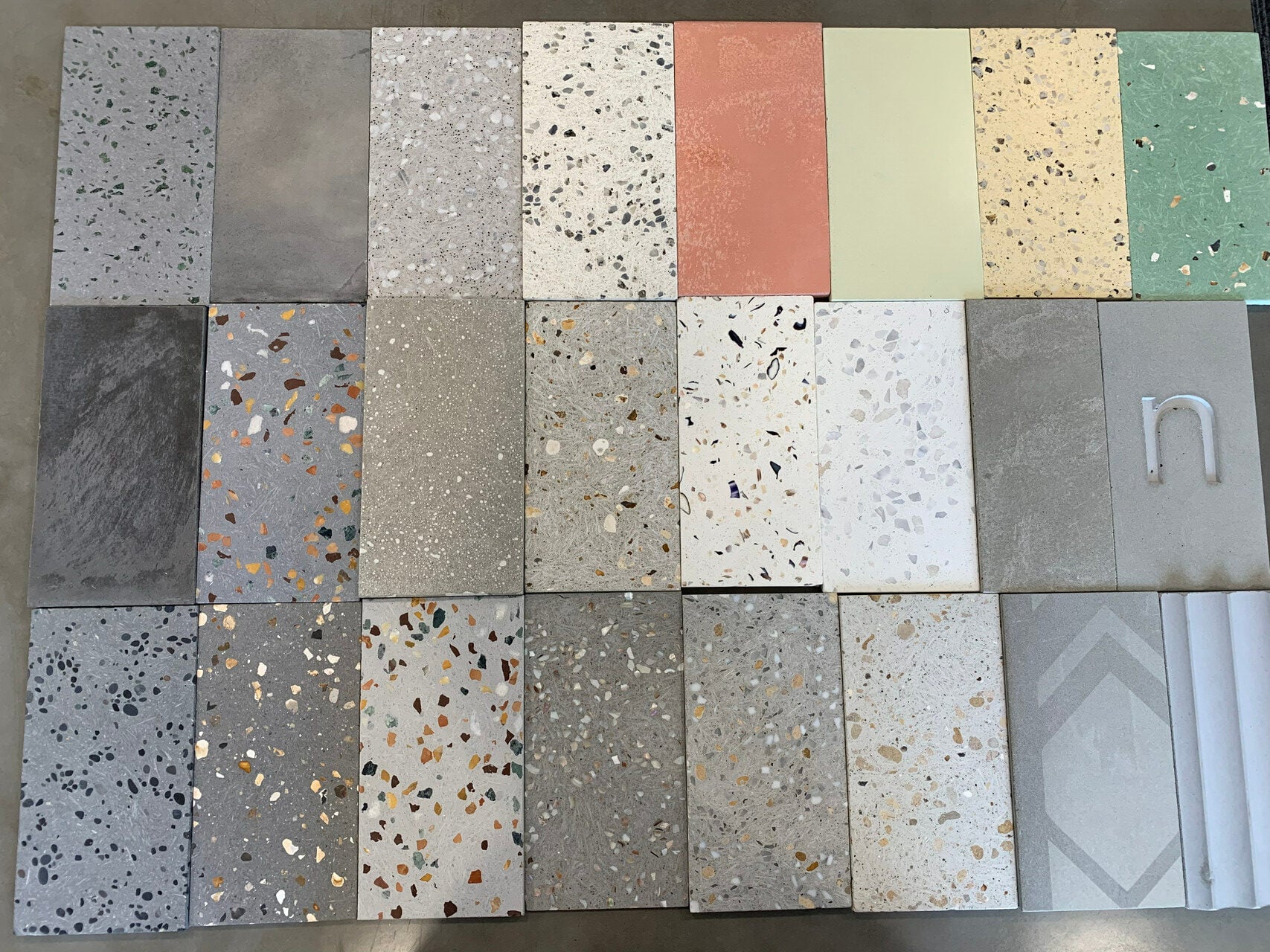
The Architectural Precast Concrete Color and Finish Guide documents the range of finish outcomes achievable through concrete – from smooth acid-etched surfaces that closely resemble limestone, to exposed aggregate finishes where quartz, granite chip, recycled glass, shells, or mother-of-pearl dominate the surface character. Pigment loading can match a brand’s Pantone reference. Aggregate selection controls texture, depth, and light response in ways that no stone quarry can replicate on demand.
MASS Concrete surfaces incorporate quartz, granite, glass, shells, and large aggregates into bespoke mixes – each combination producing a material identity that is genuinely unique to the project. From a double-height hotel reception to a compact retail servery counter, the same casting process scales to the application.
For stone, the design freedom is a different kind. The movement in a slab of Brazilian quartzite, the crystalline depth of Calacatta marble, the tonal complexity of black granite – these cannot be manufactured. They are geological facts. No pigmented concrete mix fully replicates the three-dimensional visual depth of book-matched marble. If the brief demands that specific, irreplaceable natural character, stone is the only honest answer.
Choose bespoke concrete when: the design requires custom geometry, brand colour-matching, integrated features, or seamless long-form surfaces.
Choose stone when: the brief centres on the irreplaceable aesthetic of a specific geological material and the design works within standard slab formats.
What Are the Structural and Weight Considerations for Reception Desks?
Weight is a specification variable that surfaces late and causes problems early. According to Concrete Network data on countertop thickness and weight, a standard 1.5-inch concrete surface weighs approximately 18.75 lbs per square foot. A comparable granite surface weighs approximately 18 lbs per square foot. At standard residential or light commercial cabinet specifications, both materials sit at the structural threshold for standard carcass support.
For commercial reception desks – which typically involve larger spans, integrated base structures, and higher-traffic loading – weight distribution requires explicit structural review regardless of material. The important variable is not which material is heavier in isolation, but whether the base structure and floor loading have been designed to carry the specified surface.
MASS Concrete addresses this directly: their surfaces are backed with an HD foam product that reduces overall weight, making them suitable for use on the majority of carcasses without additional structural strengthening. For larger or more complex installations, glass-fibre-reinforced concrete (GFRC) can reduce slab weight by up to 75% while maintaining tensile strength – a meaningful specification option where floor loading or handling logistics are constrained.
Stone reception desks present a similar structural conversation. The Natural Stone Institute’s Dimension Stone Design Manual addresses allowable spans, cantilever limits, reinforcement requirements, and substrate considerations for stone countertop applications – all of which apply equally in commercial reception contexts. The key point for cost consultants and project managers: structural reinforcement requirements should be assessed at the design stage, not resolved on-site.
How Durable Are Bespoke Concrete and Natural Stone in High-Traffic Commercial Environments?
Both materials are appropriate for commercial use when correctly specified. The differences lie in the nature of their durability and how they respond to use over time.
Natural stone – particularly granite and quartzite – offers compressive strength exceeding 19,000 psi and does not crack from thermal cycling under normal interior conditions. It does not cure because it already has, over geological time. Scratch resistance is genuinely superior to concrete: granite is harder than any standard cutting tool, and quartzite performs similarly. For a reception desk subject to constant contact from bags, keys, and hard objects, granite and quartzite are exceptionally resistant to surface marking.
The Concrete Countertop Institute’s quality standards for properly fabricated concrete surfaces establish clear performance benchmarks: surfaces should resist a defined set of twelve common staining agents when sealed, withstand temperatures of at least 300°F for a minimum of five minutes, and show no UV-related discolouration or degradation. Hairline cracks – a characteristic of concrete rather than a failure – are defined as any crack narrower than 0.004 inches (the thickness of a sheet of copy paper) and do not affect structural integrity. In commercial contexts, clients should be briefed on this characteristic during the specification stage, not after handover.
The honest durability summary: stone is harder and more scratch-resistant; bespoke concrete at commercial specification is highly durable but requires a more active maintenance relationship. In hospitality and high-traffic retail environments, the practical question is not whether the material can survive the use, but whether the maintenance programme supports it.
What Are the Sealing Requirements for Concrete vs Stone Surfaces?
Sealing is a specification variable that directly affects lifecycle cost and the ongoing maintenance commitment expected of the client.
For natural stone, the Natural Stone Institute’s position is nuanced: many granite countertops do not require sealing, given granite’s inherently low porosity. Where sealing is recommended – particularly for marble, softer granites, and stones with visible micro-fissures – a quality oliophobic penetrating sealer with a life expectancy of ten to fifteen years is the appropriate specification. Properly sealed stone resists both water- and oil-based staining, and routine maintenance reduces to pH-neutral cleaning after use.
For bespoke concrete, sealing is not optional – it is integral to the specification. MASS Concrete surfaces incorporate a durable sealant system as standard, engineered to protect against virtually all types of staining. The Concrete Countertop Institute grades sealed concrete stain resistance across four levels, from Grade 1 (full resistance for 24 hours against all twelve standard agents) to Grade 4 (behaviour similar to bare concrete). A commercial-grade specification should target Grade 1 or Grade 2 performance as a minimum, particularly for reception desks and bar surfaces subject to daily contact.
The practical maintenance difference over time: stone sealed with a quality penetrating sealer requires reapplication once every one to two years and routine cleaning. Concrete sealed with a topical wax or film-forming system requires more frequent attention – typically every one to three months for heavy-use zones like sink surrounds or heavily trafficked desk surfaces. Some specifiers favour concrete systems that use penetrating rather than topical sealers to reduce this maintenance frequency, though the aesthetic result differs.
For cost consultants, the ten-year maintenance cost differential is worth modelling. Concrete maintenance runs broadly £80-250 per year depending on the sealing system; stone maintenance typically runs £25-65. Over a decade, that gap compounds.
What Are the Real Budget Drivers When Specifying Bespoke Concrete vs Stone?
The common assumption – that bespoke concrete is the budget-conscious alternative to stone – does not hold at commercial specification level. Quality bespoke concrete fabrication is labour-intensive: designing the form, manufacturing, casting, curing, grinding, sealing, and finishing all require skilled time. At commercial quality, the fabrication cost reflects that.
Where concrete delivers cost efficiency is in custom form work. A reception desk that requires a non-standard geometry, integrated features, or a specific colour match that no stone slab can provide costs less to produce in concrete than to attempt in stone – if it can be achieved in stone at all. The specification comparison should account not just for material cost per square metre, but for the fabrication premium required to achieve the design intent in each material.
Key budget variables to assess:
- Structural reinforcement – concrete can often be specified with HD foam backing to avoid carcass reinforcement; large stone spans may require structural steel support
- Seam management – stone seams in long reception desks add fabrication and finishing cost; concrete can eliminate seams entirely in many configurations
- Lead time – stone fabrication is typically faster than concrete casting and curing; programme-sensitive projects may face a cost premium for accelerated concrete schedules
- Lifecycle maintenance – model the ten-year maintenance cost, not just the installation cost, particularly for hospitality and retail environments with high usage rates
- Replacement – both materials are long-term investments; neither requires replacement under normal commercial conditions, making lifecycle cost more relevant than initial material price alone
Is Bespoke Concrete Better Than Stone for Commercial Feature Surfaces?
Neither material is categorically better. Each is better for a specific brief.
Bespoke concrete is the stronger specification when the design demands precise colour matching, complex geometry, integrated features such as polished cutouts or drain grooves, seamless long-form surfaces, or a finish identity that cannot be sourced from a stone quarry. It is also the specification of choice when the project brief explicitly values material uniqueness – a reception desk that has been made for this space, this brand, this building, rather than cut from a slab that was also used in forty other projects.
Natural stone is the stronger specification when the brief centres on the irreplaceable visual character of a geological material, when the design works within standard slab formats, when the client requires the lowest possible ongoing maintenance commitment, and when programme timelines are tight.
For many high-end commercial and hospitality projects, the most compelling outcome is not a choice between the two – it is a deliberate combination. Concrete surfaces on the reception desk itself, stone on the feature wall behind it. Bespoke concrete servery counters with stone flooring. The materials can be specified to complement rather than compete, with each carrying the part of the brief it handles best.
Frequently Asked Questions
What is the difference between bespoke concrete and natural stone for reception desks?
Bespoke concrete is cast to a custom design – any shape, colour, aggregate, or finish – making it ideal for complex or brand-specific briefs. Natural stone is cut from quarried slabs, offering irreplaceable geological beauty but limited format flexibility. Concrete suits unique, seamless, or brand-matched designs; stone suits prestige briefs that value natural material character within standard slab dimensions.
Does bespoke concrete crack in commercial environments?
Hairline cracks are a characteristic of concrete, not a failure. The Concrete Countertop Institute defines hairline cracks as those narrower than 0.004 inches – the thickness of a sheet of copy paper – and confirms they do not affect structural integrity. In a properly specified commercial surface, hairline cracking is a natural material characteristic that experienced specifiers communicate to clients at the outset.
How often does a concrete reception desk need to be resealed?
This depends on the sealing system specified. Topical film-forming sealers on heavily used surfaces may require maintenance every one to three months in the highest-traffic zones. Penetrating sealer systems generally require less frequent reapplication. A quality commercial specification from MASS Concrete includes a durable sealant system engineered for stain resistance across standard commercial conditions.
Is bespoke concrete heavier than stone for a reception desk?
At standard 1.5-inch thickness, concrete and granite weigh approximately the same – around 18-18.75 lbs per square foot. MASS Concrete surfaces are backed with HD foam to reduce overall weight and avoid structural reinforcement requirements in most standard carcasses. For larger installations, GFRC can reduce slab weight by up to 75% while maintaining structural performance.
What finish options are available for bespoke concrete surfaces?
The range is extensive: exposed aggregate with quartz, granite chip, glass, shell, or mother-of-pearl; smooth acid-etched or honed finishes that read like limestone; polished surfaces with high DOI and light reflectance; form-liner textures including board-mark, fluted, and geometric patterns. Pigment loading can match a brand’s specified colour precisely. The Architectural Precast Color and Finish Guide documents the full range of achievable finishes through controlled casting and aggregate methods.
Does natural stone need sealing in commercial interiors?
For granite, the Natural Stone Institute notes that many countertops do not require sealing given granite’s inherent density. Where sealing is appropriate – particularly for marble and softer stone species – a penetrating oliophobic sealer with a ten-to-fifteen-year life expectancy is the standard recommendation. The Natural Stone Institute guidance on sealing is clear that properly sealed stone resists everyday dirt and both water- and oil-based staining effectively.
Which is better for a hotel reception desk: concrete or stone?
For a hotel reception desk where brand identity and visual distinctiveness are priorities, bespoke concrete – with its custom colour-matching, seamless form, and unique aggregate character – often serves the brief better. Where the hotel’s positioning centres on heritage, natural materials, and geological prestige, stone may be the more resonant choice. The strongest hotel reception specifications frequently combine both materials, assigning each to the surface where its qualities are most legible.
Compare Concrete and Stone Options for Your Project
The material that defines a reception desk or feature surface defines the space. MASS Concrete works directly with architects, interior designers, developers, and cost consultants from early design stage through to installation – bringing the technical depth and bespoke manufacturing capability to turn an ambitious specification into a finished surface that performs as precisely as it looks.
From reception desks and bar tops to boardroom surfaces, servery counters, and feature walls – bespoke concrete mixes can be designed to meet your brief exactly. Speak to the MASS Concrete team to compare concrete and stone options for your project, request samples, or discuss structural and sealing requirements at specification stage. Call 01202 628 140 or enquire online.