

This website uses cookies to improve your experience. We'll assume you're ok with this, but you can opt-out if you wish. Read More
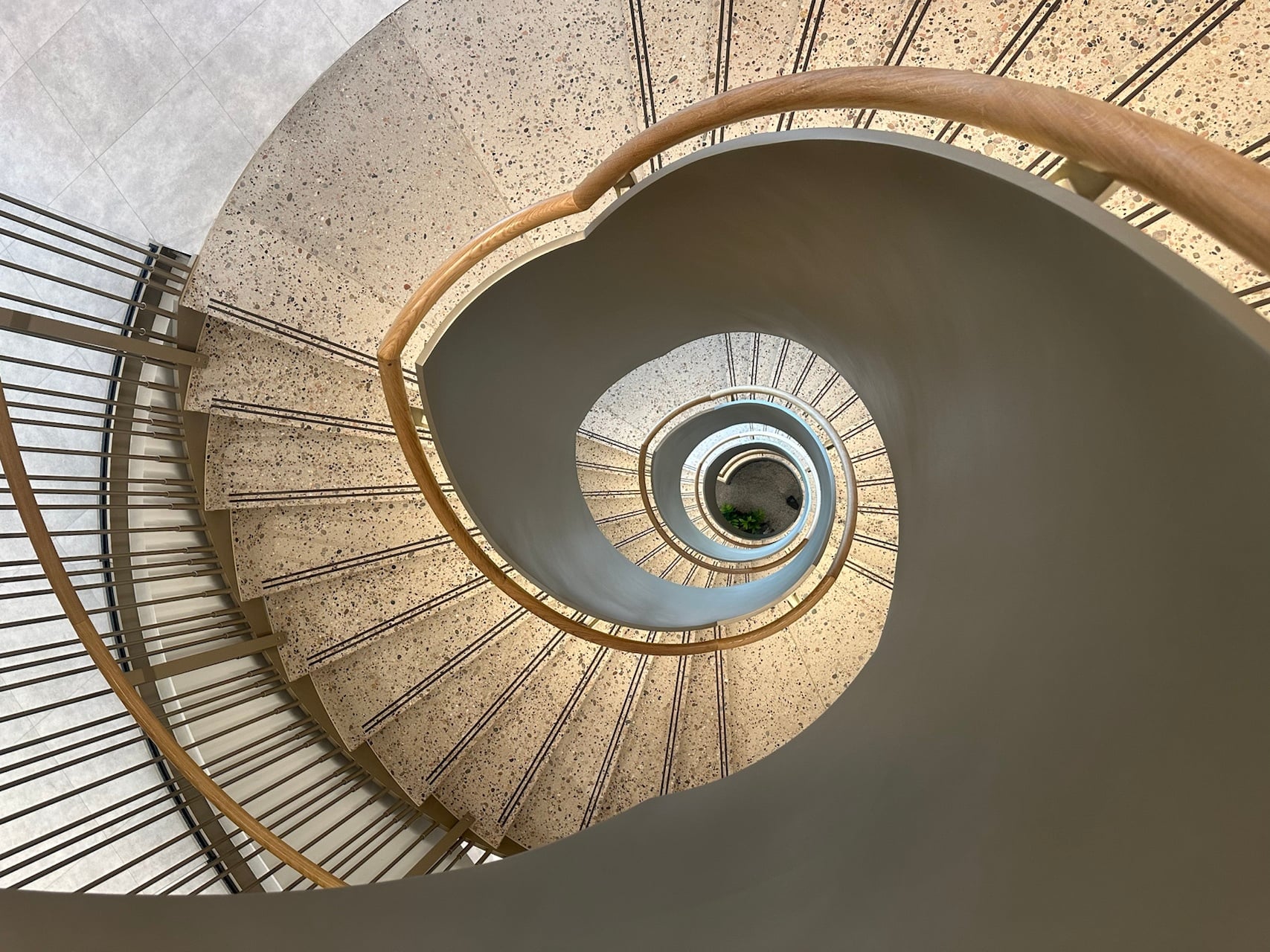
Ultra-high-performance concrete (UHPC) is a fibre-reinforced cementitious material with compressive strengths above 17,000 psi (120 MPa)—several times stronger than conventional concrete. Its strength and dense microstructure let designers cast thinner panels, sharper edges, and more ambitious forms, opening new possibilities for bespoke architectural and commercial work.
Concrete carries a reputation it doesn’t always deserve. Say the word and most people picture something heavy, thick, and brutalist enough to make a planning officer nostalgic. But the material has moved on. Ultra-high-performance concrete—UHPC—lets us cast panels a fraction of the usual thickness, hold a crisp edge, and shape geometries that ordinary mixes simply can’t support.
For architects, interior designers, and specifiers, that shift matters. It changes what concrete can do in a reception space, on a façade, or as a single bespoke piece of furniture. This guide explains what UHPC is, why it behaves so differently from standard concrete, and where it’s already proving itself in refined, ambitious design.
Table of Contents
What is UHPC?
UHPC is a category of cementitious material engineered for exceptional strength, durability, and a remarkably dense internal structure. It’s built from a carefully optimised mix: fine sands, cement, silica fume, high-range water reducers, a very low water-to-binder ratio, and steel or synthetic fibres that give the material its tensile toughness.
That recipe is what sets it apart. According to the Federal Highway Administration’s state-of-the-art report, UHPC combines high compressive strength, sustained post-cracking tensile strength, and superior durability compared with conventional concrete. The American Concrete Institute’s emerging technology report from Committee 239 traces how the material has evolved from a laboratory curiosity into a recognised technology now used across façades, canopies, shells, and structures in aggressive environments.
The short version: UHPC isn’t ordinary concrete made a little better. It’s a different material, designed from the molecule up to do things its predecessor cannot.
How does UHPC compare to traditional concrete in strength and durability?
Strength is where the gap becomes obvious. Conventional structural concrete typically reaches compressive strengths of around 3,000 to 6,000 psi. UHPC routinely exceeds 17,000 psi (120 MPa), and many mixes push well beyond that—a peer-reviewed state-of-the-art review records compressive strengths reaching into the hundreds of MPa under optimised conditions.
Durability is the second half of the story, and arguably the more important one for long-life commercial projects. The same review notes that UHPC offers better durability than conventional concrete thanks to its discontinuous pore structure. Fewer connected pores means water, chlorides, and other aggressive agents struggle to penetrate the material. The practical result is a surface that resists weathering, abrasion, and degradation far longer than a standard mix.
For a specifier weighing options, the decision criteria are fairly clear: choose UHPC where slenderness, longevity, or a refined finish matters more than raw cost per cubic metre. Where a thick, conventional slab will do the job unseen, standard concrete remains the sensible choice. UHPC earns its place when the design intent demands more than bulk can deliver.
How does UHPC enable thinner sections and finer details?
Because UHPC is so strong and tough, it doesn’t need the heavy reinforcement that bulks out conventional concrete. That single fact unlocks a great deal.
The clearest demonstration is the Carapace Pavilion, a design-build prototype developed at the University of Southern California for Joshua Tree National Park. The thin-shell structure is only two inches thick in places and contains no conventional rebar—a feat made possible entirely by UHPC’s compressive strength, which the project team recorded as exceeding 25,000 psi. The five panels were colour-matched to the surrounding rock formations and cast in a single mould, then transported and installed in a single day.
Thinner sections bring obvious advantages for our kind of work:
- Lighter panels that ease handling, transport, and on-site fixing
- Slimmer profiles for wall panels, floor panels, and stair treads, where bulk would otherwise dominate a space
- Finer detailing—debossed signage, crisp flutes, intricate textures—held cleanly in a dense, fine-grained surface
- Reduced structural load, which can simplify the substructure a panel hangs from
For bespoke panelling in a double-height reception or a feature staircase, that combination of slenderness and strength is exactly what lets concrete read as elegant rather than imposing.
How does UHPC achieve sharper edges and more ambitious forms?
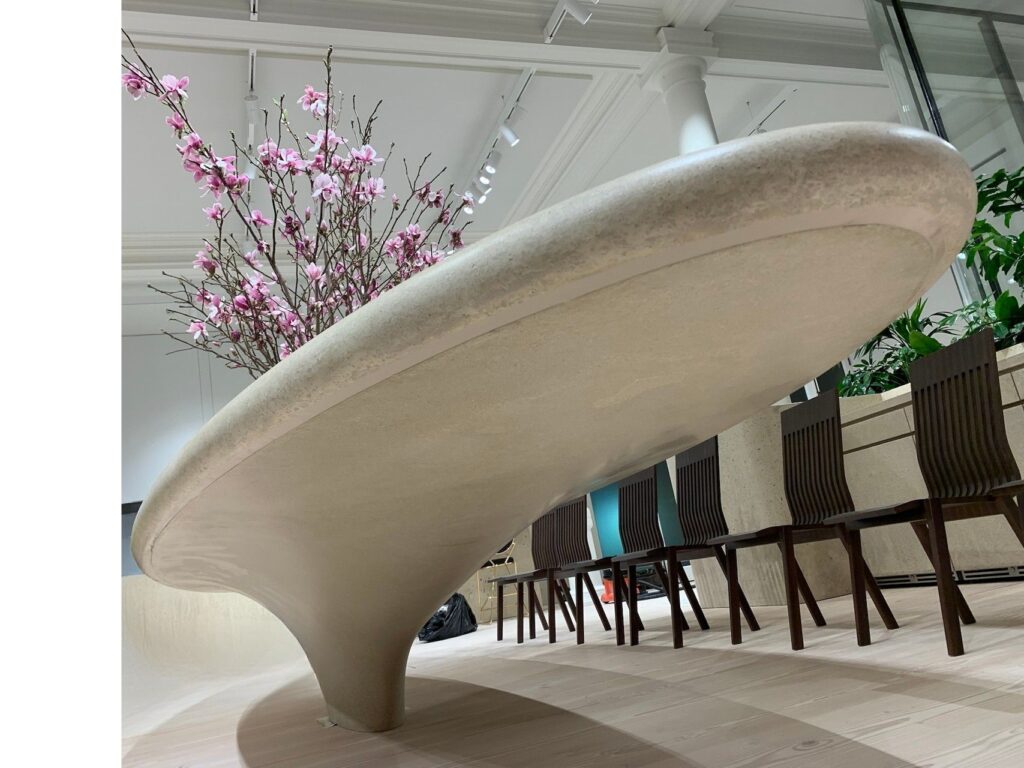
A dense, fine-grained mix takes detail the way few materials can. Where coarse aggregate forces compromises at an edge or a corner, UHPC holds a clean arris and a sharp profile straight from the mould.
That fidelity is what makes ambitious geometry achievable. The Carapace Pavilion used a diagrid structure and an anticlastic—double-curved—shape for strength, with all the complexity driven by a parametric design tool and a digitally fabricated mould. Complex curves, faceted surfaces, and self-supporting shells move from the realm of the difficult to the genuinely buildable.
For an architect or designer, this is the real prize. UHPC doesn’t just make concrete thinner; it makes concrete more expressive. Sharper edges, tighter tolerances, and forms that would crack or sag in an ordinary mix become part of the design vocabulary.
What are the applications for UHPC in bespoke commercial products?
UHPC isn’t confined to façades and structures. Its slenderness and durability make it a natural fit for bespoke commercial products, where a refined profile and a long service life both matter.
Foster + Partners’ Tiers collection, produced with Barcelona-based Escofet, is a clear example. The outdoor furniture range—a bench, a perch, a high table, and a low stool—is made from UHPC precisely to achieve durable elements with a sleek, thin profile. Used individually or arranged together, the pieces show how the material supports furniture that is both hard-wearing for public spaces and elegant enough for considered interiors.
The same logic extends across the bespoke pieces our kind of work involves:
- Reception desks and check-in counters with slimmer, sharper edges
- Servery counters, bar tops, and tea-points where durability meets refined detail
- Display plinths, sculptures, and street furniture cast in ambitious forms
- Vanity tops, sinks, and surfaces that resist heat, scratching, and daily wear
Where conventional concrete would force a bulky, cautious profile, UHPC lets a bespoke piece stay slender without sacrificing strength.
What is the future of UHPC in design?
UHPC is shifting from specialist novelty to a more accessible part of the designer’s palette. As mix designs mature and fabrication knowledge spreads, the material is appearing in a wider range of commercial and architectural projects—from infrastructure, where the FHWA report tracks growing adoption, to the bespoke product and furniture work championed by studios like Foster + Partners.
The direction of travel is towards more digital fabrication, more complex geometries, and tighter integration between design intent and manufacturing. Parametric tools, CNC-cut moulds, and prefabrication—all central to the Carapace Pavilion—point to where bespoke concrete is heading: pieces that are designed, refined, and cast with a precision that older methods couldn’t match.
Why is UHPC important?
UHPC matters because it dismantles the long-standing assumption that concrete must be heavy and crude. It gives designers a material that is stronger, more durable, and far more refined than conventional concrete—without abandoning the versatility, fire resistance, and longevity that made concrete valuable in the first place.
For specifiers, the importance is practical. UHPC reduces weight, eases handling, holds fine detail, and lasts longer in demanding commercial environments. It lets a finish read as crafted rather than bulky, which is precisely what a premium brief usually demands.
How to start integrating UHPC into your projects
Bringing UHPC into a project is most successful when it’s considered early, at the design stage rather than bolted on late. A few practical steps help:
- Define the design intent first. Decide where slenderness, durability, or fine detail genuinely matters—those are the points where UHPC earns its place.
- Engage a specialist early. Bespoke UHPC work benefits enormously from early-stage design input on mix design, mould-making, fixings, and handling.
- Plan a sample-led approval process. As with any bespoke concrete, agree texture, colour, and finish benchmarks on a sample that reflects the real piece before production begins.
- Understand quality control. Standards such as ASTM C1856/C1856M set out how UHPC specimens are fabricated and tested, which helps frame sensible conversations about consistency and performance with your supplier.
- Coordinate fixings and installation. Even though UHPC is lighter, weight, fixing methods, and access still need planning with your contractor.
Bring your most ambitious concrete designs to life
UHPC turns concrete from something heavy and unyielding into a material capable of slender panels, sharp edges, and the kind of forms that used to live only on a mood board. For architects, designers, and specifiers chasing a refined, bespoke finish, it’s one of the most exciting developments the material has seen.
If you’re exploring where UHPC and bespoke concrete could elevate your next project, the best first step is a conversation. Speak to our team about your design intent, and we’ll help you understand what’s possible—from early-stage input through to a sample-led approval process and final installation.