

This website uses cookies to improve your experience. We'll assume you're ok with this, but you can opt-out if you wish. Read More

Specifying bespoke concrete isn’t the same as ordering ready-mix for a slab. You’re not buying a commodity – you’re buying precision, repeatability and the ability to sleep at night. Whether you’re commissioning a statement staircase, a fair-faced façade or polished internal floors, the supplier you choose will make or break the project.
Here are the twelve factors that matter when choosing a bespoke concrete supplier for high-end work.
1. Proven Track Record in Your Exact Use Case
Not all concrete is created equal. External façades, internal countertops and terrazzo-like polished floors might all be “bespoke concrete,” but they’re fundamentally different products with different failure modes.
Ask for case studies of similar scale, geometry, exposure conditions and finish – not just “we did something architectural once.” If you’re specifying precast cladding panels for a coastal site, you need a supplier who understands XS3 exposure class and has managed chloride-induced corrosion before. If it’s a polished floor in a retail environment, you need someone who’s controlled shrinkage cracking and joint detailing at that scale.
Request references. Speak to the architect, contractor and end client. Ask what went wrong and how it was resolved.
2. Technical Capability and Mix Design Control
Choosing a bespoke concrete supplier demands more than observing the generic strength classes. You need a supplier who can tune every variable: strength, shrinkage, permeability, colour consistency, aggregate selection, fibre or rebar strategy, weight and thermal performance.
For exterior applications, durability design is non-negotiable. According to BS EN 206 and BS 8500, concrete must be specified for the correct exposure class – whether that’s freeze-thaw resistance (XF), chloride attack from de-icing salts (XD) or seawater (XS). Each class dictates minimum cement content, maximum water/cement ratio and air entrainment requirements.
For architectural finishes, control over cement source, aggregate grading, pigment batching and water content is critical. Colour consistency lives or dies in the batching plant. If the supplier can’t explain their process for maintaining batch-to-batch repeatability, walk away.
3. QA/QC Maturity: Behaving Like Aerospace, Not Guesswork
Quality assurance is where luxury suppliers distinguish themselves. You want a partner who operates with the rigour of aerospace manufacturing, not someone who “eyeballs it and hopes.”
A credible supplier will have:
- A written Quality Manual outlining their production and inspection procedures
- Inspection and Test Plans (ITPs) that define hold points, witness points and acceptance criteria at every stage
- Batch records with full traceability – cement type, aggregate source, admixture dosage, mixing time and ambient conditions
- Documented curing protocols including temperature monitoring, moisture control and minimum curing durations
- Traceability systems that can answer “Which batch made which panel?” without a forensic investigation
According to the NPCA Quality Control Manual, plants producing architectural precast must maintain records of raw material certifications, mix qualifications and product inspections for a minimum of three years. Mock-up production must be tied to specific batch data and quality records with unique identification for every piece.
If your supplier can’t produce this documentation on demand, they’re not serious.
4. Samples, Mock-ups and a Clear Approval Pathway
Finish samples are liars unless they’re made under actual production conditions. A 150mm square sample cast on a lab bench tells you almost nothing about how a 3m × 1.5m panel will look after vibration, demoulding and curing.
Require the following:
- Control samples kept by both supplier and site team for colour and finish reference throughout production
- Full-size mock-up or first article for complex geometries, critical finishes or anything visible at eye level
- Agreed acceptance tolerances for colour variation, surface voids (bughole density and size), edge crispness, sheen and flatness
PCI Manual MNL-117 recommends that architectural precast mock-ups be viewed at the same distance they’ll be seen in the structure – typically no less than 6 metres (20 feet). Mock-ups should be signed off by the architect or their representative and retained at the plant as the reference standard for production units.
Don’t proceed to full production without formal approval. It’s not bureaucracy – it’s avoiding £50,000 remakes.
5. Tolerances and Dimensional Stability
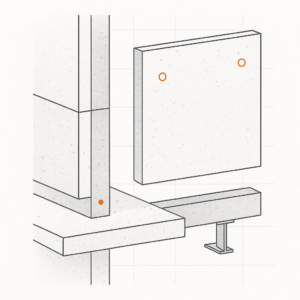 High-end architecture lives or dies by millimetres. A 2mm twist over 3 metres might be invisible in blockwork but catastrophic in a fair-faced feature wall.
Define tolerances explicitly for:
- Flatness and straightness
- Thickness variation
- Squareness and perpendicularity
- Edge radii and reveals
- Joint line alignment
Ask how the supplier manages shrinkage, warping, curling and long slender elements. Differential shrinkage between face mix and backup mix is a common culprit for bowing in architectural panels. According to PCI MNL-135 (Tolerances for Precast and Prestressed Concrete Construction), product tolerances must account for both manufacturing limits and erection/installation variables.
A serious supplier will provide tolerance schedules as part of their shop drawings – and explain what happens if they’re exceeded.
6. Finish Capability (and Honesty About What’s Achievable)
Off-the-form, honed, polished, acid-etched, sandblasted, bush-hammered, exposed aggregate: each finish has its own failure modes and limitations. A credible supplier will tell you what they won’t guarantee – and why. That honesty is a green flag.
For example:
- Off-the-form finishes are hostage to formwork quality, release agent and concrete flowability. Perfect uniformity is a myth.
- Polished finishes are sensitive to aggregate hardness, cement type and grinding sequence. Expect variation.
- Exposed aggregate depends on retarder timing, aggregate distribution and washing technique. Results vary.
If a supplier promises perfection without caveats, they’re either inexperienced or lying. The best suppliers manage expectations and define what “acceptable variation” means before you commit.
7. Fixings, Anchors and Interface Detailing
For panels, stairs, façade elements, benches and coping units, the devil is in the connections. Bespoke concrete is only as good as how it’s fixed to the building.
Look for:
- In-house structural engineering (or a trusted partnered engineer) for anchor design, lifting inserts, deflection analysis and movement accommodation
- Coordination capability with substrate tolerances, waterproofing, DPCs, thermal breaks and sealant joints
- Evidence of past problem-solving around water shedding, staining run-off and differential movement
According to NPCA standards, all lifting inserts must be certified for rated working load limits with appropriate safety factors and embedded steel must be protected from corrosion when necessary. Dissimilar metals must not be in contact.
A supplier who handwaves the interface details will leave you with leaks, stains and liability.
8. Installation Competence (or Controlled Installer Network)
You can manufacture perfection and still ruin it in one afternoon. Installation is where dreams go to die.
Clarify:
- Who installs? Who seals? Who signs off on completion?
- Are method statements, handling plans and protection strategies provided in advance?
- What’s the process for dealing with damage during delivery or installation?
- Is there a formal handover and snagging procedure?
The best suppliers either have their own installation teams or work with a vetted network of specialist installers. Either way, accountability must be crystal clear. If the supplier says “installation is not our problem,” expect it to become your problem.
9. Lead Times, Logistics, Packaging and Handling
Bespoke concrete is fragile and heavy – a truly joyful combination. Lead times for complex pieces can stretch to 12–16 weeks once approvals, mock-ups and production scheduling are factored in.
Ask about:
- Crating and edge protection standards
- Lifting point locations and capacity
- Delivery sequencing and site access requirements
- What happens if an element arrives damaged? Are spare units included? What’s the remake lead time?
A supplier who hasn’t thought through logistics will leave you with cracked panels, missed install dates and a site full of very unhappy people.
10. Durability Strategy and Maintenance Plan
Concrete isn’t maintenance-free. It’s maintenance-aware – if you’re lucky.
Ask about:
- Sealer systems: What’s specified and what’s the recoat cycle?
- Stain resistance, slip resistance (if relevant) and cleaning compatibility
- What happens if someone pressure-washes it or uses the wrong cleaner?
The supplier should provide a handover Operation & Maintenance manual that doesn’t make facilities managers want to quit. It should explain what products to use, what to avoid and how to inspect for early signs of deterioration.
If the answer is “just leave it,” you’re talking to the wrong people.
11. Compliance, Insurance and Commercial Hygiene
Boring but essential. Make sure the supplier can demonstrate:
- Compliance with relevant standards and testing regimes (e.g., BS EN 206 conformity criteria, exposure class verification, BS 8500 mix design compliance)
- Product liability and professional indemnity insurance (especially if they’re designing fixings or advising on structural interfaces)
- Clear warranties with defined exclusions
- CDM and H&S competence if they’re involved on site
According to BS EN 206, every concrete delivery must be accompanied by a delivery docket containing mandatory information including producer details, strength class, exposure class, consistency class and time of mixing. Retain all documentation for a minimum of 10 years.
Don’t assume compliance. Verify it.
12. Sustainability and Ethical Sourcing
If your practice is serious about embodied carbon, don’t accept “it’s concrete, it lasts ages” as the whole sustainability story.
Ask about:
- Cement replacement strategies: Ground granulated blast-furnace slag (GGBS) and pulverised fuel ash (PFA/fly ash) can replace 35–50% of Portland cement and significantly reduce embodied carbon while improving durability
- Environmental Product Declarations (EPDs): Third-party verified reports (compliant with ISO 14025 and EN 15804) that quantify the environmental impact of the product. NRMCA operates an EPD programme for ready-mixed concrete and precast products
- Recycled aggregates and waste minimisation
- Local sourcing to reduce transport emissions
- Ask to see their environmental policy and mission statement.
A supplier with verified EPDs, transparent sourcing and a genuine commitment to low-carbon mixes is no longer a nice-to-have – it’s table stakes for any credible practice.
Choosing a bespoke concrete supplier is about finding a partner, not a vendor. You need someone who understands risk, embraces accountability and treats every pour like it’s going in their own home.
Ask hard questions. Demand documentation. Visit their plant. Speak to past clients. And if they can’t answer your questions with specificity and honesty, keep looking.
Because in bespoke concrete, there’s no such thing as “near enough.”